
Guest Voice: Using my platform to enact change in the CMT community
Being quiet about disability rights was never my style
Written by |

My name is Amanda Knightly, but the internet knows me as Misa on Wheels. I got this name at my first anime convention nearly two decades ago, while cosplaying as Misa from the popular anime series “Death Note.” One of the fellow attendees I met that weekend, now a longtime friend, recognized the character I was dressed as, noticed my wheelchair, and proclaimed, “You’re Misa! But on wheels! So, I’m going to call you Misa on Wheels!”
Shortly after earning my nickname, I started a Facebook page to keep in touch with fellow cosplayers and friends in the convention community. While I intended the page as a place to share photos and geeky conversations, it soon became a place to encourage fellow cosplayers and the home of my motto: “Cosplay is for everyone.”


Amanda Knightly is a regular cosplayer at pop culture conventions. (Courtesy of Amanda Knightly)
I have had the honor of appearing as a guest at numerous conventions over the years. I’ve spoken about topics such as positive body image, bullying awareness in the cosplay community, and characters with disabilities in geek culture and popular media. In recent years, my page has focused more on the “on Wheels” part of my nickname. It’s now a platform for disability rights, awareness, and advocacy.
I was diagnosed with Charcot-Marie-Tooth (CMT) disease at age 2 and started using a wheelchair full time by age 10. To me, having CMT has always meant learning to do the same things as those without CMT, in my own way.
One of my earliest memories of figuring out how to do something I was determined to do despite my condition happened when I received my first PlayStation 1 for Christmas back in the ’90s. A standard video game controller is designed to be held with both hands and operated with working fingers. Although I have always lacked the working fingers part, I was in no way going to let that stop me from spending countless hours playing Spyro the Dragon.
I invented my own way of using the controller. I sat cross-legged on the couch with the controller flat on the cushion in front of me and positioned my hands so I could press all the buttons from there. Over the years, I have tweaked this technique several times and have become quite a difficult opponent in Tony Hawk’s Pro Skater.
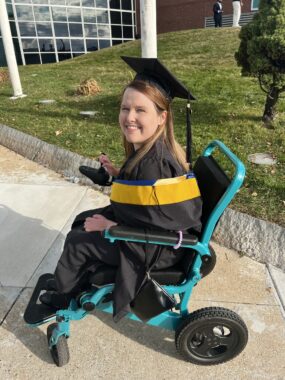
Amanda Knightly graduates from Southern New Hampshire University. (Courtesy of Amanda Knightly)
Video gaming is not the only thing I have had to adapt because of CMT. Other honorable mentions include typing on a standard keyboard using the sides of my hands, skateboarding while sitting down, living on my own in college, working full time for many years, cosplaying, and recently graduating from grad school with my master’s in industrial-organizational psychology.
Living with CMT may have weakened my lower arms and lower legs over the years, but it has strengthened my drive to help others and provide my own voice to those who need it most. While my condition comes with its share of struggles, I am so grateful for the joys in my life and for the wonderful communities I have had the pleasure of serving and being a part of.
Whenever I am asked when my disability advocacy work began, I realize that I have been advocating all my life. From my earliest years as a child proudly stumbling around in leg braces and refusing to hide them with pants or long dresses, to serving as the Muscular Dystrophy Association’s Goodwill Ambassador for New Hampshire for several years in middle school and early high school, to the online platform I have managed nearly all of my adult life, being quiet about disability rights was never my style.
To submit your own Guest Voice for publication on Charcot-Marie-Tooth News, please email your idea to our community editorial manager at [email protected] with the following included in the subject line: “Guest Voice: Charcot-Marie-Tooth News.”
Note: Charcot-Marie-Tooth News is strictly a news and information website about the disease. It does not provide medical advice, diagnosis, or treatment. This content is not intended to be a substitute for professional medical advice, diagnosis, or treatment. Always seek the advice of your physician or other qualified health provider with any questions you may have regarding a medical condition. Never disregard professional medical advice or delay in seeking it because of something you have read on this website. The opinions expressed in this column are not those of Charcot-Marie-Tooth News or its parent company, Bionews, and are intended to spark discussion about issues pertaining to Charcot-Marie-Tooth.



Barry Crutchley
Im an 84 year old man living in England. You are an inspiration.